by Helen Dennis, October 2021 ~
My great aunt Valmai was a bit of a thrill-seeker. She died before I was born, so I never met her. As a 1920s ‘flapper’ her life was filled with social engagements, dances, tennis parties, travel, fun and frivolity. She also longed to fly. This is the story of one of her adventures in the air.
‘Valmai’s Thrilling Air Race’ | by Helen Dennis, October 2021 ~
My great-aunt Valmai longed to fly. It was something she expressed several times in her diary written in the late 1920s, the era of the ‘flapper’. Valmai had an adventurous spirit and was recently described by her (now elderly) niece Penelope as a ‘go-getter’.
Valmai was born Beatrice Valmai JENKINS at Darling Point, Sydney on 15 October 1906. She spent her early years on the family property Herbert Park in Armidale. She had two older brothers: Richard (my grandfather) who was 13 years older than her, and Victor who was nine years her senior. She also had a younger sister Maud. Valmai was born when her mother Beatrice was 44 years old. She probably wouldn’t have remembered her father George who died when she was just three years old.
Valmai began a diary just after she turned 21, and even though she wrote for only four or so years, what she wrote in that time provides a powerful insight into her adventurous nature.
While she was in Armidale she led a full life of dancing, tennis parties, camping and generally travelling the countryside enjoying herself. She maintained an enthusiastic interest in horses, music and travel. She was also a keen photographer in an era when photography was far more complex than it is today. She enjoyed reading, and her interests ranged from novels to Shakespeare to psychology.
She sought out many activities that her mother would probably have disapproved of. She describes horse-riding with a friend on a ‘scorchingly hot’ day, and swimming in her ‘birthday suit’ in the river on the way home to cool off. She rode rapids over jagged rocks with a group of friends, which she discovered was ‘hard on one’s sit-upon’.
In 1928 Valmai and her mother left Armidale and moved to Rose Bay in Sydney. Valmai settled in to city life with apparent ease. Her day-to-day life consisted of a series of social engagements, music lessons and entertainments in the eastern suburbs of Sydney. She was not expected to earn a living, or pursue a career. Valmai’s sister Maud also moved to Sydney at the same time, but went against the family’s expectations and took up nursing.
Valmai could drive a car, and drove her mother and sister around Sydney regularly. Her thirst for adventure is evident in her writing. After having her first surf on a surfboard at Palm Beach, she declared ‘I won’t rest content till I have one of my own now and learn to manage it by myself’.
In February 1932 she bought a racehorse, seemingly on a whim. A newspaper article stuck into the back of Valmai’s diary describes this purchase:
‘I hear Valmai Jenkins’s latest domestic pet is a pure-bred racehorse, a descendant of Carbine. This attractive Rose Bay lass is noted for her “spur of the moment” fancies. She first caught sight of the animal in Centennial Park the other day, and closed the deal with the owner there and then. At the moment she’s stabling her steed in the family garden, where he has already broken down a gate or two and wrought havoc among the roses.’
‘Valmai’s racehorse’, World, 16 February 1932.
Valmai wrote on more than one occasion of her interest in flying, and she promised herself that she would ‘learn to fly at the first opportunity’.
She took a number of joy-flights, and describes one exciting flight she took over Sydney in graphic detail. She was ‘never so near to vomiting’ as a result of stunts including aerial circles, loop-the-loops, mid-air engine stalls and a series of sharp turns upon decent into landing. Despite regularly imploring the pilot to stop ‘stunting’ – which he clearly ignored – she declares ‘I wouldn’t have missed that fly for anything’!
Immediately after this ‘vomit-inducing’ joy-flight, Valmai wrote in her diary of the feelings she experienced when flying:
‘One feels right away from everything that is bad. Except for the steady roar of the propeller, peace reigns supreme – peace and beauty; I had a wonderfully elevated feeling when I landed and felt thoroughly at peace with the world and everything seemed just absolutely right. I wish I could fly myself; someday I will.’
Diary entry 30 march 1929
In July 1929, while on a social visit, Valmai met a female pilot named Miss Wallace. She had a fascinating conversation with Miss Wallace in which they discussed flying and aeroplanes ‘for the best part of an hour’. She was clearly impressed, and very interested, in the fact that Miss Wallace had learnt to fly.
Valmai’s mother died in August 1931 and it was not long after this that Valmai became involved with the Ladies of the Air flying race.
First prize in the ‘Ladies’ Air Tourney’ competition was 12 months’ worth of flying lessons. (An alternative prize, a new car, was offered if the winner didn’t wish to have flying lessons, but that was probably not an option for Valmai!)
The prospect of twelve months’ worth of flying lessons would have been inducement enough, but also on offer was the chance to participate in a thrilling air race over Sydney!
It is not at all surprising that Valmai entered the competition.
The competition was organised by the NSW Aero Club for the benefit of the Benevolent Society, a local charity. The Aero Club was sponsoring the event, in part, to ‘meet the growing interest in aviation shown by women’.
The ‘tourney’ was to be a race between 12 planes, flown by qualified pilots over a course of about 20 miles. The event was to take place in August 1932. Prior to the actual air race, where 12 girls would each participate as a passenger in one of the race planes, it was necessary to whittle down the 60 entrants to just a dozen. This was done by splitting the girls into 12 groups of five, and setting them the very appropriate ‘society girl’ task of fund-raising. The girl from each group to raise the most money would earn the right to a spot in the race.
Valmai won her group stage and was to fly with a pilot named Goya Henry in a Moth, a bi-plane that may have looked something like this:
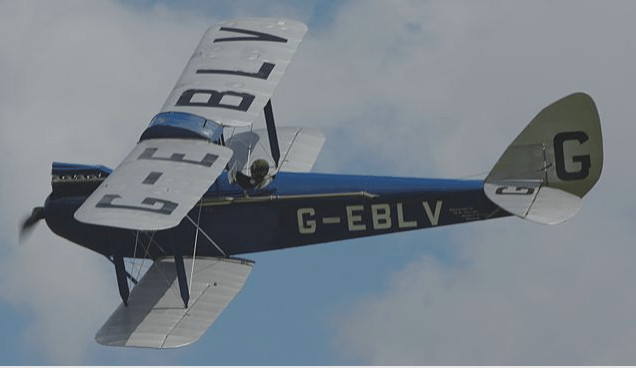
A 1920s de Havilland DH.60 Moth – a two-seat recreational and training aircraft.
Various other types of planes were listed for the other competitors including Gypsy Moth, Hermes Moth and Avian. With my limited knowledge of planes, and a quick Google search, I ruled out the later 1930s model of ‘Tiger Moth’. It seems the ‘Moth’ was the original version built in the 1920s, and I feel this is most likely the model Valmai flew in, but of course I could be wrong!
Further in keeping with the ‘society girl’ feel of the whole affair, about a month before the race a fund-raising ball was held. The newspapers of the time delighted in the events of the ball and described a ‘plane storm’ – a squall of over 2,000 miniature planes flown by the revellers over the ballroom.
Various aero-themed entertainments kept the ladies and their partners thoroughly amused. These included an ‘air serpent belching smoke and bellowing noises … swooping down upon the crowded ballroom’, and an air race where the ladies propelled model planes along strings across the ballroom.
In addition, of course, there was a fashion parade which included bridal wear! This is a sign of the times in which Valmai was living, as was the fact that her race-day outfit was also described in the newspapers. She was ‘one of two women passengers who wore a hat during the race and her ensemble of maroon and beige matched the Moth plane in which she flew’. Valmai clearly had style as well as nerve!
The race took place at Hargrave Park in Liverpool, an airfield that no longer exists (it is now part of the residential suburb of Warwick Farm). Each plane was given a handicap, and the race consisted of a number of turning points, some four miles away from the airfield. The total length of the race was about 20 miles.
On race day, 13 planes ultimately competed, with the race beginning mid-afternoon.
‘Spinning, rolling and wheeling, their wings gleaming in the brilliant sunshine, a score of aeroplanes entertained thousands of people at Hargrave Park Liverpool.’
‘Lady of the Air’, Sun, 20 August 1932.
In what sounds like a thrilling finish, Valmai finished a close second – ‘by about two lengths’. The Sun stated that: ‘It seemed for some seconds that Miss Jenkins would catch her rival.’ The planes were ‘ripping the air at 100 miles an hour’. Perhaps Valmai’s experience joy-riding and loop-the-looping over Sydney provided appropriate preparation for this race!
It is interesting to note that the pilot of Valmai’s plane, Goya Henry, was considered somewhat of a maverick in flying circles at the time. He had lost part of one leg when he had crashed a plane on a beach at Manly in 1930 killing his passenger. So when he flew with Valmai, he was flying with a prosthetic leg.
Goya Henry reportedly had an ‘adventurous nature and penchant for challenging the authority of regulatory bureaucracy’. His adventurous nature was perhaps not dissimilar to that of Valmai’s!
A few years after Valmai’s flight with him, Henry was suspended for breaches of the air navigation regulations. He considered the sentence unjust, so defied the order and kept flying. His licence was then suspended indefinitely, so he flew his plane underneath the Sydney Harbour Bridge (which was illegal) – deliberately, in defiance of the regulators. A short time later he took the Commonwealth to the High Court and won the case, but a further crash a year or so later ended his flying career.
Goya Henry’s most famous plane (the one that he flew under the Harbour Bridge), the ‘Jolly Roger’, is now housed at the Powerhouse Museum. Unfortunately this is not the plane that Valmai would have flown in.
It must, indeed, have been thrilling for Valmai to fly in the ‘Air Tourney’ with the dare-devil character Goya Henry as her pilot!
Following the race, yet another ball was held where the winner and runners-up were presented with their trophies. I wonder if Valmai felt a little envious when the race winner Mollie Bowden enthusiastically accepted as her prize the year’s-worth of flying lessons, rather than the new car.
For her second place, Valmai received a miniature inscribed silver aeroplane.
I’m not aware that Valmai ever did have flying lessons. She married Richard MASON in 1934 when she was 28, had three children, but then tragically lost her husband to the war. She was a widow at age 38, was diagnosed with cancer and died shortly before her 42nd birthday. Her two boys were left in the care of her sister Maud, and her daughter was cared for by her brother Victor and his wife.
Bibliography
- Diary of B Valmai Jenkins, transcribed by Marilyn Mason, original held by Marilyn Mason.
- Newspaper cutting stuck into diary, ‘Valmai’s Racehorse’, The World, 16 February 1932.
- ‘Lady of the Air’, Sun, 20 August 1932, p. 5, http://nla.gov.au/nla.news-article228883912, accessed 3 October 2021.
- ‘Flying Fever: Ladies of the Air Tourney’, Sun, 6 April 1932, p. 14, http://nla.gov.au/nla.news-article229893849, accessed 2 October 2021.
- ‘de Havilland Moth’ Wikipedia page, https://en.wikipedia.org/wiki/De_Havilland_Moth, accessed 2 October 2021.
- ‘Plane Storm Thrill’, Daily Telegraph, 13 July 1932, p. 4, http://nla.gov.au/nla.news-article246304482, accessed 1 October 2021.
- ‘Visitors to Air Race’, Sun, 21 August 1932, p. 26, http://nla.gov.au/nla.news-article228874786, accessed 1 October 2021.
- ‘Secrets of Sydney Past’, http://sydneypast.blogspot.com/2014/12/hargrave-park-aerodrome-and-warwick.html, accessed 1 October 2021.
- ‘Tourney Race To-Morrow’, Sun, 19 August 1932, p. 16, http://nla.gov.au/nla.news-article228883463, accessed 2 October 1932.
- ‘Air Thrill Finish’, Sun, 21 August 1932, p. 4, http://nla.gov.au/nla.news-article228875051, accessed 1 October 2021.
- ‘Museum of Applied Arts and Sciences’ website, https://collection.maas.museum/object/420778, accessed 2 October 2021.
- ‘Australian Dictionary of Biography’ website, https://adb.anu.edu.au/biography/henry-henry-goya-6643, accessed 2 October 2021.
- Sydney Morning Herald, 23 August 1932, p. 4, http://nla.gov.au/nla.news-article16909923, accessed 2 October 2021.
- ‘No 1218 Pacific Highway, Pymble’, The Historian, Official Journal of the Ku-ring-gai Historical Society, by Marilyn Mason, copy received by email from Marilyn Mason 1 October 2021.
- ‘A Charming Study’, Sydney Mail, 22 June 1932, p. 24, http://nla.gov.au/nla.news-article160080737, accessed 1 October 2021.
 Unravelled