by Helen Dennis, November 2023.
Andrew & Margaret Coventry: The original settlers of ‘Oban’ Run ~
Andrew Coventry was a relatively young, but nevertheless experienced, distiller when he established the first Scotch Whiskey distillery in Camlachie in Scotland in 1834. He had a wife and a growing brood of children to support but within two years, his business had failed. Seduced by a smooth-talking Reverend, Andrew convinced his wife that their future lay across the seas, amidst the greener pastures of the fledgling British Colony of New South Wales. And so began the young family’s momentous journey.
Andrew Coventry was born in about 1800 in Scotland; probably in Perthshire. When he married Margaret Harvey in 1827, he was living in Port Dundas, an industrial area of Glasgow located on a branch of the Forth and Clyde Canal, home to numerous breweries and distilleries. Margaret was a native of Port Dundas.
Soon after the birth of the couple’s fourth child, the family moved to Camlachie, on the outskirts of Glasgow. There, Andrew and two business partners established, alongside the Camlachie Burn, the Camlachie Distillery. Almost immediately, the three entrepreneurs renamed the distillery ‘Whitevale’.
The distillery was the first in the Camlachie area, but Andrew was in good company; just down the road at Kilmarnock, a young man by the name of John Walker first bottled his unique, and rather popular, blend of malt whiskies.
Unfortunately, the late 1830s was an unsettled time in Scotland and within two years the Whitevale Distillery had failed. Andrew was declared bankrupt and lost his business. Shortly afterwards, the Coventry family set sail for Australia.
Andrew was 35 years old, and Margaret 30, when they departed Greenock near Glasgow aboard the Portland on 24th July 1837. With them were their four children: Thomas (aged nine), William (seven), Margaret (two), and baby Andrew who was just four months old.
The Coventrys travelled as bounty immigrants which meant that their passage had been funded by a NSW colonist on the understanding that Andrew (and possibly Margaret) would work for him once they arrived. The Portland’s passenger list recorded Andrew’s occupation as a farm servant and Margaret’s as a seamstress.
The settler who sponsored the Coventrys – and many others aboard the Portland – was Andrew Lang, brother of the Reverend John Dunmore Lang. Reverend Lang was a staunch Presbyterian who believed the Colony’s morals would be enhanced by boosting the number of virtuous free settlers and abolishing the convict class. Lang arranged passage for numerous Scots during the 1830s and was in fact aboard the Portland when it sailed with its Coventry cargo.
For Andrew Coventry, the tragic losses of two babies, his failed business, and the disagreeable surroundings of Camlachie – with its industrial pollution and foul Burn – might have made Lang’s lure of emigration seem particularly appealing.
The Colonist newspaper reported that the passengers of the Portland arrived in Sydney on 3rd December 1837 ‘in excellent health’. In fact, twenty-five children had died of measles during the voyage and many of the adults had suffered from scurvy.
The Coventrys’ sponsor, Andrew Lang, owned land in the Hunter Valley near Maitland. Mr Lang had sponsored numerous immigrants – seemingly too many to employ by himself. Upon arrival, Andrew Coventry was placed into the service of the Dumaresq family at ‘St Heliers’ near Muswellbrook. By early 1843 Dumaresq had moved the Coventry family to New England where he put Andrew in charge of his property, ‘Saumarez’.
Meanwhile, Margaret Coventry continued to expand the family’s clutch of offspring, giving birth to twelve children over twenty-two years.
The Coventrys arrived in New England amid a flurry of land grabs. In the early days of NSW, it had been illegal to venture outside the ‘limits of settlement’ set by the government. But many adventurous pastoralists had ignored these regulations and, by the time New England was officially proclaimed a district in 1839, several ‘squatterages’ had already been established.
It is rumoured that while Andrew was employed at Saumarez, his colleague Jock McDonald, introduced him to some ‘vacant’ land north of the then tiny settlement of Armidale. Evidence of Andrew’s potential claim to this land first appears on a map published in the 1843 edition of the Royal Geographical Society Journal.
The earliest official record of Andrew’s lease of ‘Oban’ dates from 1st July 1844. However, as the baptism records of the children suggest, it is likely the family did not live at ‘Oban’ until sometime after their son George’s birth in September 1846.
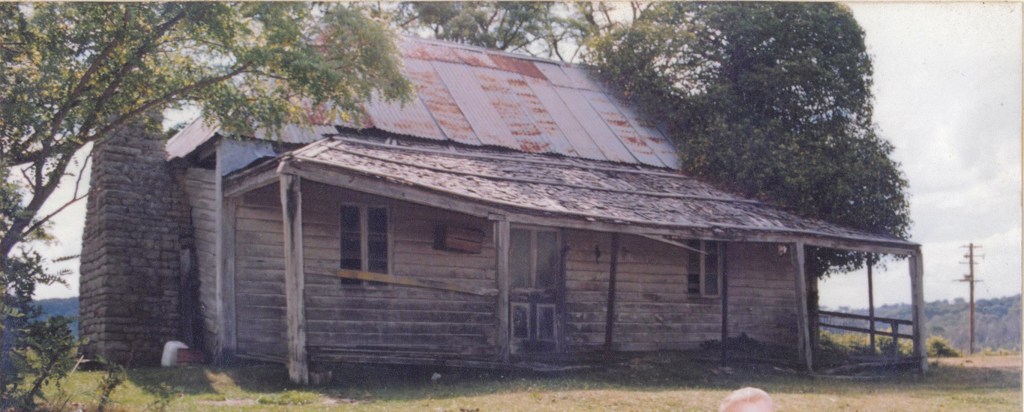
‘Oban’ homestead, 1988.
This photograph, held by the Armidale Family History Group, was taken in 1988. The building was demolished shortly afterwards. When I visited in 2023, only the brick chimney remained.
The name ‘Oban’ is rumoured to have been bestowed in honour of Andrew’s friend Jock Macdonald’s Scottish hometown. The veracity of that claim can’t be tested, but in the absence of any evidence to the contrary, it is, if nothing else, a charming tale.
Andrew seems to have been well respected by his neighbours. He was remembered by Joshua Scholes (one of the first settlers to arrive in the Glen Innes district) as, ‘one of the finest old gentlemen I ever knew. He was good to everybody, black and white; he was well-liked by them all’.
He also appears to have had a sense of humour, as a notice published in the Maitland Mercury in 1852 reveals:
Notice: A grey mare has been running on my Run since 1849, is branded ME on near shoulder; has a Grey Filly running with her. Any person proving the Mare to be theirs, by paying the service of the horse and this advertisement, may have them. Andrew Coventry. Oban, New England, Nov 15, 1852.
In 1858, reminiscent of similar experiences in Scotland, Andrew ran into money troubles. He had borrowed money from Rundle, Dangar & Co which he could not repay, and his creditors directed that ‘Oban’ be sold. This event proved to be but a hiccup in the Coventrys’ long association with ‘Oban’. The property was transferred to J Dickson in January 1859, but was again described as ‘the station of Andrew Coventry’ in September of the following year. The Coventry family retained ownership of ‘Oban’ well into the 20th century.
When Margaret Coventry died in October 1870, five of the couple’s twelve children had predeceased her. Three babies – Jeanie, Charles and Katherine – died as infants. Fourteen-year-old George died in February 1861 after a fall from a horse. Wanted in several states, the couple’s eldest child Thomas died aged 33 on Boxing Day 1861. He was found dead in his hut by his employer at the property ‘Rosewood’ about 100km west of Rockhampton. It appears that his death was not notified to the authorities until the following August.
Andrew Coventry died just two years after his wife, in March 1873. It was reported that ‘the loss of his wife seriously shattered him’ and that ‘increasing years scarcely fitted him to bear the severity of the blow’.
Andrew and Margaret Coventry are buried in the private cemetery at ‘Oban’ station with three of their children: Charles, George and James.
 Unravelled
One thought on “Andrew & Margaret Coventry”