~ by Helen Dennis, 6 October 2024 ~
This weekend is a long weekend in New South Wales. Many people travel; others simply enjoy an extra day off work. Once upon a time, however – as the discovery of a cache of my aunt Penelope’s photos led me to discover – demonstrations, processions and sports days were held on what we now call the ‘October long weekend’ (or Labour Day).
In October 1948, when she was twenty-five, my aunt Penelope Jenkins organised – in her capacity as Sister in charge of Male Ward at the Armidale & New England Hospital – the hospital’s float in Armidale’s street parade. The parade – or ‘Procession’ as it was referred to in the Armidale Express – involved two dozen exhibits including pipe bands, horses, motor cars and school students. The parade was the prelude to a fund-raising carnival in aid of establishing a Police-Citizens Boys’ Club in Armidale.
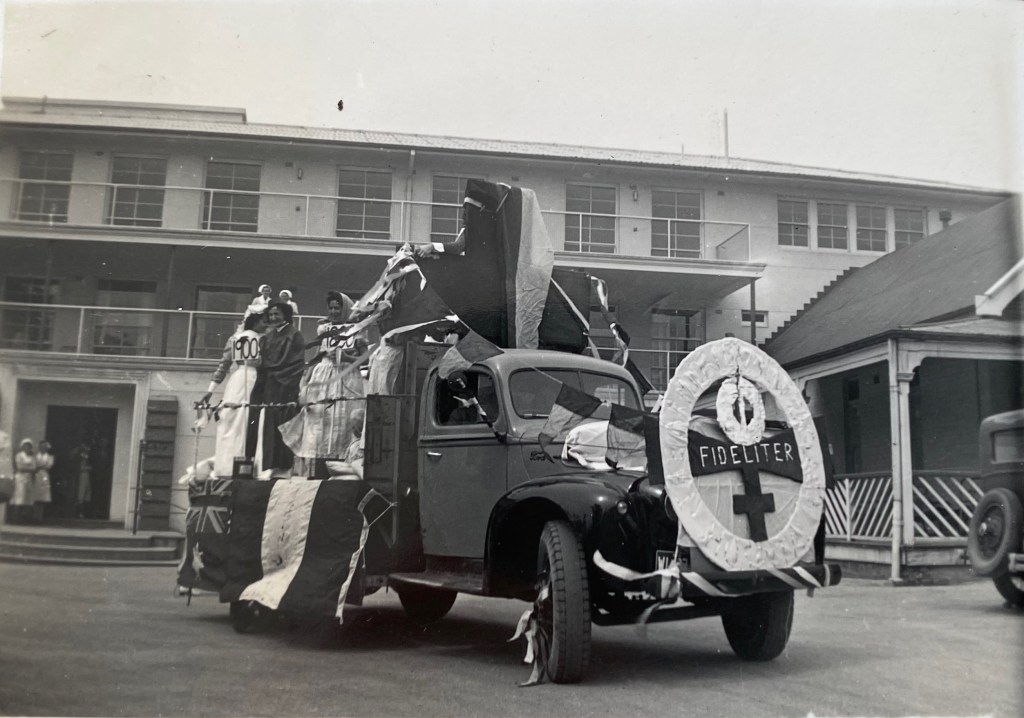
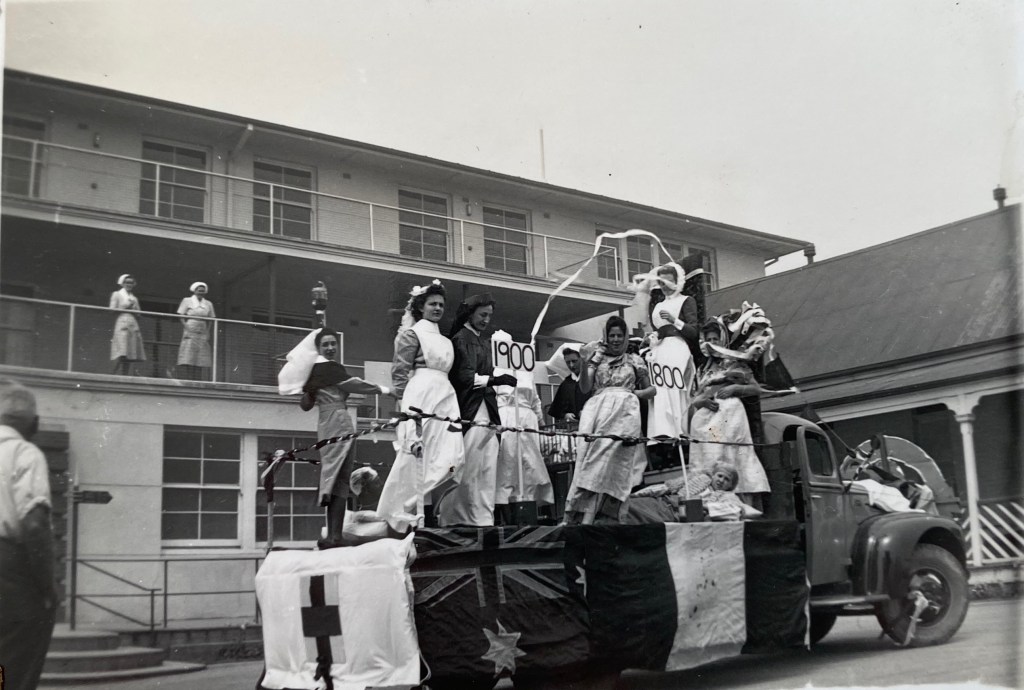
Penelope and her fellow nurses decorated the tray of an old Ford truck in the theme of ‘nursing through the ages’. The first era – the early 1800s – was depicted by drunken nurse Gamp from Dickens’ novel, Martin Chuzzlewit. The fictional Mrs Gamp was a dissolute and slovenly old woman. She wore a decrepit black gown, a tattered shawl and a grimy bonnet. Her nose was red and swollen, and she had about her a ‘smell of spirits’. Nurse Gamp was said to have been so unfazed by the rigours of her profession that she ‘went to a lying-in or a laying-out with equal zest and relish’. Penelope’s hospital float bore two Mrs Gamps – one on either side – each swigging merrily from an (empty) gin bottle as they laxly guarded their ‘dying patient’.
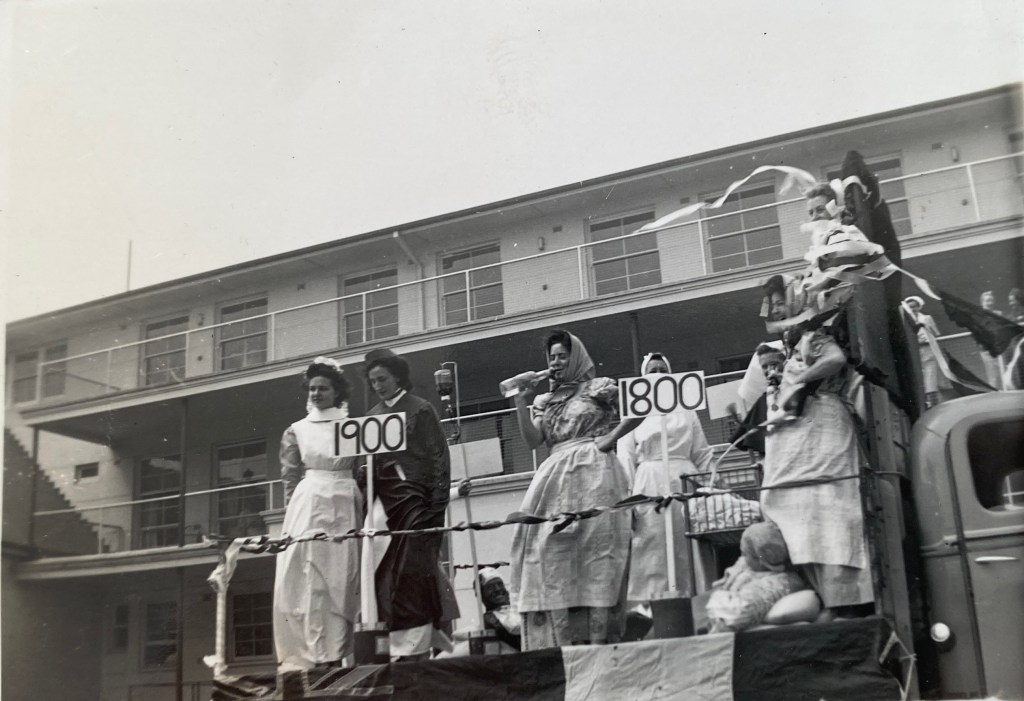
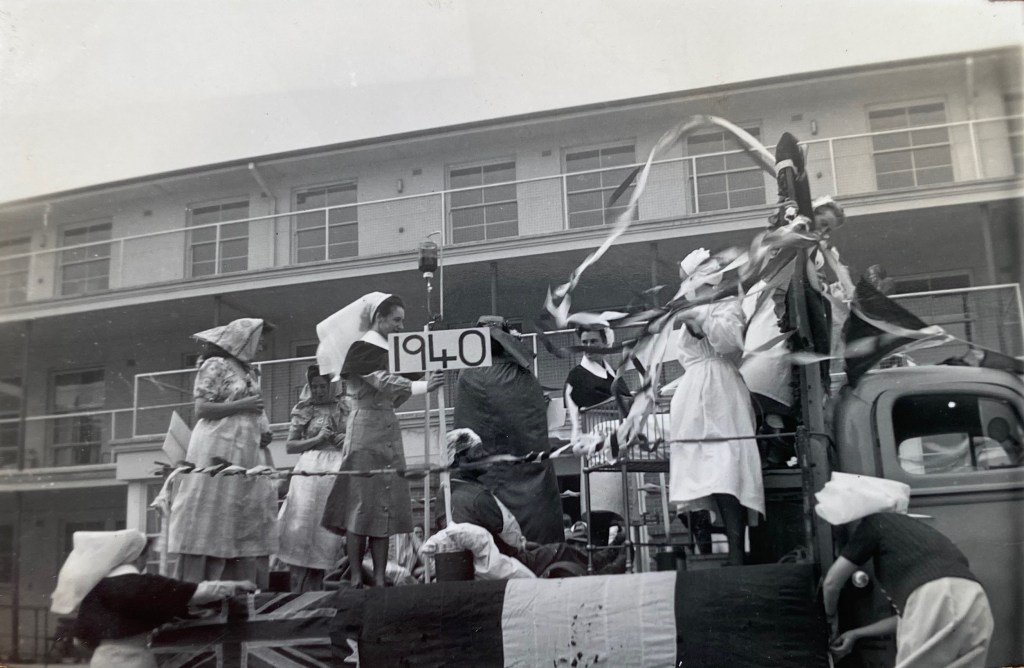
As the years progressed, so too did the quality of care dispensed by the nursing profession. This was reflected in the hospital float’s depiction of subsequent eras: from the saintly Florence Nightingale with her lamp, to the 1940s nurse with her heavily bandaged (and bloodied) war casualty.
The Procession began at Albion Park, near the wooden footbridge that led to the City Baths. It proceeded along Beardy Street and ended near the Showground. Towards the front of the parade, a young boy dressed as a Canadian Mountie sat proudly astride a pintsize white Shetland pony called Prince. A black pony named Digger followed closely behind pulling its driver Beryl Rossiter in a little cart.
Students from De La Salle College followed, marching in front of Armidale’s Robinson Shield representative Rugby League team. Armidale’s female hockey players – dressed in ‘pullovers and football shorts’ – followed; their attire aimed at drawing attention to the skill of the male footballers.
Next came Penelope’s hospital float, draped with flags including the Red Cross, the Australian flag and the Union Jack. Colourful bunting adorned the Ford’s hood and a very large handmade replica of Armidale & New England Hospital’s badge was affixed to its front; conceivably obscuring the driver’s view, but apparently not proving enough of a hindrance to have bothered anyone.
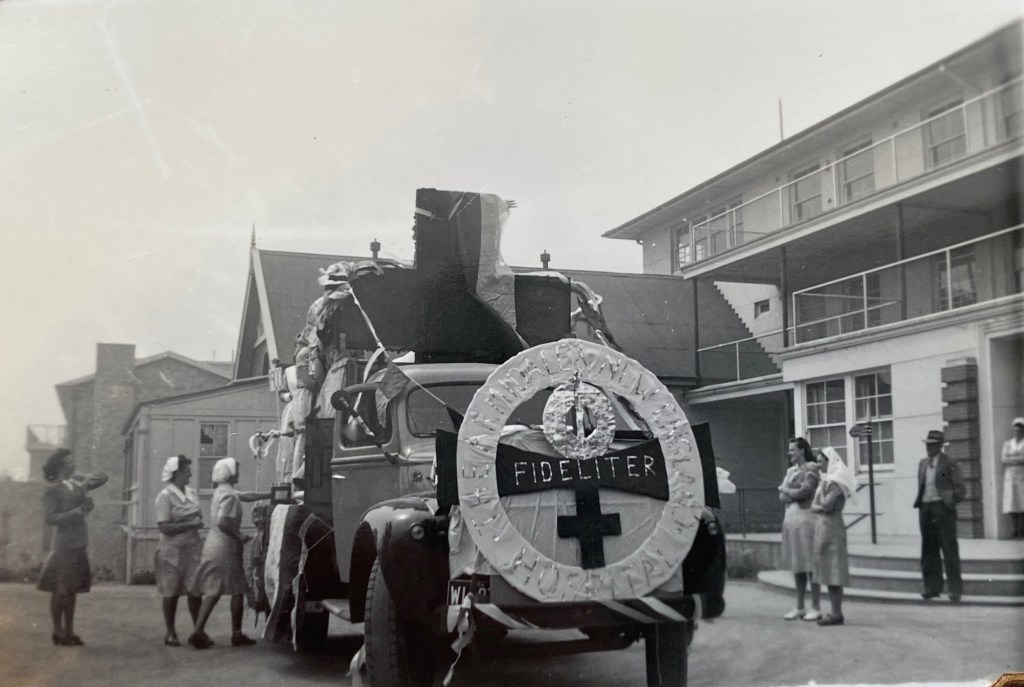
The hospital float was followed by students from The Armidale School, the Armidale City Band, and a ‘Diamond T transporter with a Matilda tank manned by members of the Citizen Army and cadets of Armidale High School’. The presence of the 25-ton Matilda tank had been keenly anticipated by the editors of the Armidale Express for several weeks.
The Fire Brigade, the Teachers College, the Progress Associations and several bands – including the ‘Guyra Girls’ Marching Bands’ – were represented, as were the Musketeers, Legionnaires and Armidale’s motor traders.
Armidale Ambulance’s new Chevrolet preceded the Postal Institute float which showcased the various post office departments including the telephone exchange, a morse operator, cable-joiner and linesman. The semi-trailer carrying the post office’s elaborate exhibit was ‘bordered in mail sorting bags, and on both sides were miniature telephone posts and wires’. Telegram boys rode their bicycles alongside; at times having to dodge two galivanting clowns who wove precariously in and out of the Procession from one float to another.
As the parade ended, the carnival at the Showground had just begun. Penelope’s younger sister Mary Jenkins – then aged 12 – won several horse events and was crowned Champion Girl Rider. In addition to numerous equestrian events, there was the 100-yard race, the broad jump, and an open mile footrace. Boys under twelve competed in a bike race; older males in the motorcycle bending race. There was a woodchop event and three tug-o-wars in which Dangarsleigh defeated the Police, the Pipe Band defeated the Armidale Scrubbers, and the Armidale Band defeated its Guyra counterpart.
Curiously, the public holiday was, at the time, only gazetted year-by-year, town-by-town. In 1948 in Armidale, the holiday wasn’t gazetted until May. Demonstrations calling for an eight-hour work day had been held sporadically in New South Wales since the mid-1800s, however, there was no uniformity in the date across the state. Each town or district did its own thing – some observed the day in May as May Day, some demonstrated in March, and others in October. The day was first recognised as a public holiday in Sydney in 1885. Once workers’ demands for an eight-hour work day had been achieved (by the early 1900s), Labour Day (or ‘Eight-Hour Day’ as it had become known) morphed to become ‘Six-Hour Day’. It was under that banner that Armidale celebrated its public holiday on the 11th of October 1948.
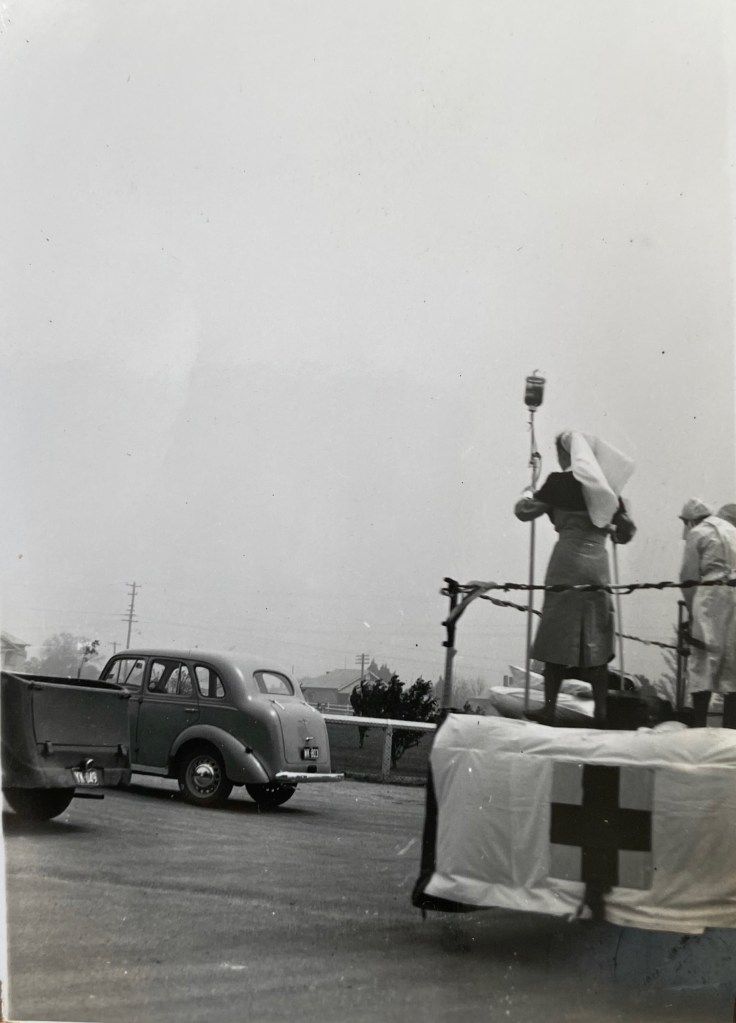
Although the weather leading up to the Procession in 1948 had been ‘warm and sultry’, the temperature dropped dramatically on the holiday Monday, courtesy of a howling wind that blew in a thick layer of dust to enshroud the town. The Express reported that the dust storm was so severe that Armidale was in fact ‘blacked out’. Penelope’s photos show streamers flying wildly about the hospital float, and the nurses hanging onto their bonnets. Although the photos are in black and white, the heavy dust haze can be seen clearly in the background.
Despite the atrocious conditions causing a reduction of entries at the sports carnival, the Procession was said to have been the ‘best seen in Armidale for years’.
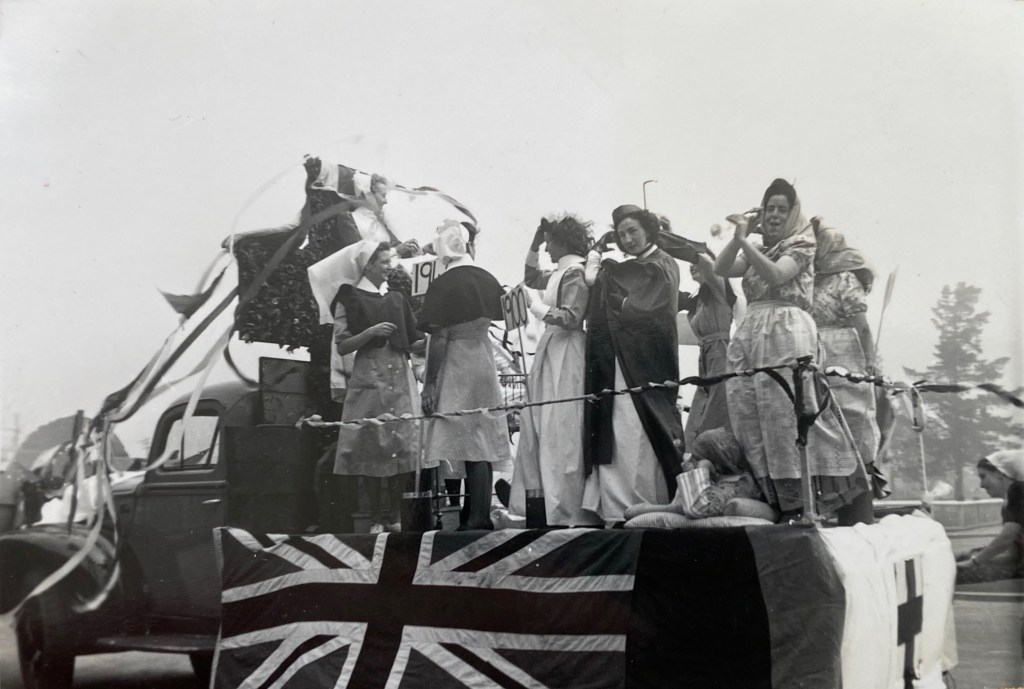
All appear to be in a jovial mood despite evidence of the strong wind and suffocating dust storm.
References:
Most information on the 1948 Procession in Armidale came from :
- Armidale Express, 11 October 1948, pp 4 and 8 (‘Adverse Weather Fails to Halt Procession’, ‘Armidale Blacked Out’, and ‘Sports Carnival’).
- ‘Police-Citizens Boys’ Club, Six-Hour Day Carnival’, Armidale Express, 15 September 1948, p 8.
Supplementary info on Eight/Six-Hour Day from:
- Gazetted public holiday – ‘Application for Holiday’, Armidale Express, 19 May 1948, p 8; and under ‘Alteration of Boundaries’, Armidale Express, 9 June 1948, p 3.
- ‘Universal Six-Hour Day’, Armidale Express, 5 November 1948, p 13.
- ‘Eight Hour Day’, Lithgow Mercury, 11 October 1919, p 2 [for background/history of Eight Hour Day].
- ‘A Glorious Thing: Celebrating Labour Day in NSW’, State Library NSW website.
 Unravelled