Jenkins family ownership
c.1884-1930 ~
Annotated map ~
I’ve only ever had a vague idea of the properties owned by the Jenkins in the early 1900s. Property names are mentioned and forgotten and recalled, and ambiguous locations thrown around. So, to disentangle the muddle in my head, I created an annotated map that represents two generations of the property ownership of the Jenkins, in the New England region, beginning with my great grandfather George Henry Vaughan Jenkins. The timeline covers roughly the period 1884-1930s.
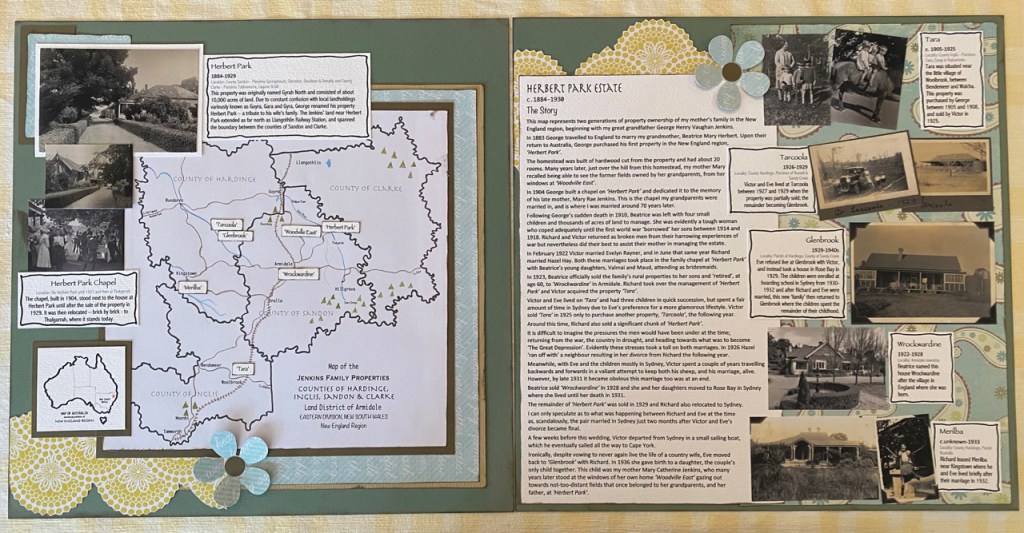
The map is interwoven with my story of the two generations of Jenkins and the properties they owned at the time. I completed the map as part of a Uni assessment, but had to reduce the word count of my story significantly, and the resulting map/story lacks much of the detail I would’ve liked to include in the narrative. This blog is the longer version of that story.
The story
In 1883 George Henry Vaughan Jenkins travelled to England to marry my grandmother, Beatrice Mary Herbert. Upon their return to Australia, George purchased his first property in the New England region. The 10,000-acre property, purchased from Christopher Legh, was named ‘Gyrah North’ but due to constant confusion with local landholdings variously named ‘Guyra’, ‘Gyra’ and ‘Gara’, George renamed his property ‘Herbert Park’ – a tribute to his wife’s family.
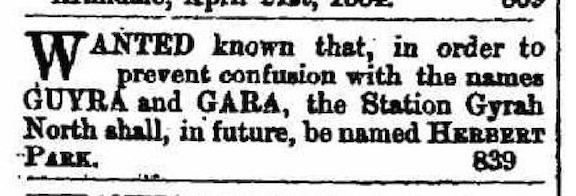
According to Land Registry index records, George’s land near Herbert Park at times extended as far north as ‘Llangothlin Station’, and spanned the boundary between the counties of Sandon and Clarke.
The homestead was built for the young couple, from hardwood cut from the property and had about 20 rooms.
George and Beatrice’s first child, Sybil, was born at Herbert Park in February 1885, but sadly only lived for ten weeks. She died from ‘convulsions’ and is buried in the Armidale cemetery. Beatrice lost another daughter (stillborn) before giving birth to Richard in 1893 and Victor in 1897.
George bought, sold, leased and mortgaged various parcels of land and there are numerous references to land in both Sandon and Clarke counties in the indexes. In 1893-94 there is a reference to a conveyance to ‘Biggs and others’ which could be the sale of part of Herbert Park that later became ‘Thalgarrah’.
In 1904 George built a chapel on Herbert Park and dedicated it to the memory of his late mother, Mary Rae Jenkins. The chapel was attached to the southern wing of the homestead. Beatrice trained the chapel choir, which consisted chiefly of employees from the station, and many Sunday services and celebrations were held in the little chapel.
George expanded the ‘family estate’ (which I call ‘Herbert Park Estate’) between 1905-08 with the purchase of ‘Tara’, near Woolbrook.
Back then the railway line was in use all the way from Sydney to the Queensland border, and a detailed railway map from 1933 shows railway stations at both Woolbrook, near Tara, and at Llangothlin. Tara would’ve been easily accessible by rail to Sydney.
Two more children were born; Beatrice Valmai in 1906, and Emily Maud in 1909, both known by their middle names. Valmai was christened in the chapel at Herbert Park. Maud was born in England while the family was visiting Beatrice’s family. Richard and Victor were at school in England at the time. In late 1909, George returned to Australia ahead of his family, and upon his return suffered a heart attack while in his office at Herbert Park. He did not survive.
Following George’s sudden death in 1910, Beatrice returned to Australia with her two very small daughters. The boys returned from school in England a short time later. Beatrice was thus left with four young children and thousands of acres of land to manage. She was evidently a tough woman who coped well until the first world war borrowed her sons between 1914 and 1918.
During the war, while her sons were away fighting, Beatrice was hospitalised and required an operation (I have not discovered what for). She also began selling off bits of land. The Armidale Chronicle reported that she transferred 4,381 acres to WC Hillard in August 1917.
Richard and Victor returned as broken men from their harrowing experiences of war but nevertheless did their best to assist their mother in managing the estate.
In about 1918-19 Beatrice established the company Herbert Park Ltd and the properties Herbert Park and Tara were transferred to this company. A newspaper report in 1920 mentions that Tara consisted of at least 11,000 acres of land.
In February 1922 Victor married Evelyn Rayner, and in June 1922 Richard married Hazel Hay. Both these marriages took place in the family chapel at Herbert Park with Beatrice’s young daughters, Valmai and Maud, attending as bridesmaids. Eve’s daughter, Penelope, recalls that Eve and Hazel were ‘best friends’. Hazel was also one of Eve’s bridesmaids.
In 1923, the company Herbert Park Ltd was wound up, and Beatrice officially sold the two rural properties to her sons. She retired, aged 60, to ‘Wrockwardine’ in Armidale which she had purchased during 1922. Richard took over the management of Herbert Park and Victor acquired Tara (which by then also included land in the neighbouring parish of Muluerindie).
There are various ads/snippets in local newspapers at the time which give a hint as to who was living where. In November 1922 Beatrice advertised for a cook/laundress at Wrockwardine and in January 1923 ‘Mrs Richard Jenkins’ (Hazel) advertised for the same at Herbert Park.
In November 1923 the Daily Telegraph reported that ‘Mr & Mrs V Jenkins [Eve and Victor] of Tara Woolbrook are at present visiting Sydney’. The couple’s three children were all born in Sydney.
Beatrice took advantage of her new-found relative freedom and in January 1924 she took a trip with Valmai and Maud to England where they visited relatives and spent some time being tourists.
In 1925, Victor sold Tara and he and Eve took a house at Point Piper in Sydney (this is where Victor jnr was born). According to a later deposition of Victor snr’s, they lived there for about nine months. Victor then purchased ‘Tarcoola’, which he described as being ’30 miles out of Armidale’. Eve and Victor moved to Tarcoola and lived there until 1927 when they travelled back to Palm Beach (where Eve’s parents lived).
Meanwhile, Richard and Hazel’s family at Herbert Park had grown with the addition of two baby boys: George (later known as ‘Sandy’) and David. The couple also gained a new neighbour, James ‘Jock’ Dalglish who bought ‘Gara Station’. Richard sold a significant chunk of Herbert Park in February 1926, and this portion later became known as ‘Loch Abba’. Why did I mention a random neighbour, you might ask? Wait for it …
It is difficult to imagine the pressures the men would have been under at the time; returning from the war, the country in drought, and heading towards what was to become ‘The Great Depression’. Evidently these stresses took a toll on both marriages. In 1926 Hazel ‘ran off with’ Jock Dalglish – that new neighbour from ‘Gara Station’ – resulting in Richard and Hazel’s divorce the following year.
The story is that Hazel and Jock ‘ran away to India’. However they must’ve first spent some time in Sydney, as Hazel’s address in the divorce papers is given as Potts Point up until at least the end of November 1926. Three weeks after Richard & Hazel’s divorce became final, in the middle of May 1928, Jock and Hazel were indeed married in Madras (in India). I’ve been told the two small boys had been left ‘with an ancient aunt at Coolangatta’ while Hazel spent a year in India with Jock.
With Eve and the children spending a great deal of time in Sydney, Victor spent several years in the late 1920s travelling backwards and forwards in a valiant attempt to keep both his sheep, and his marriage, alive. He sold a portion of Tarcoola in 1928; the portion he kept was named ‘Glenbrook’.
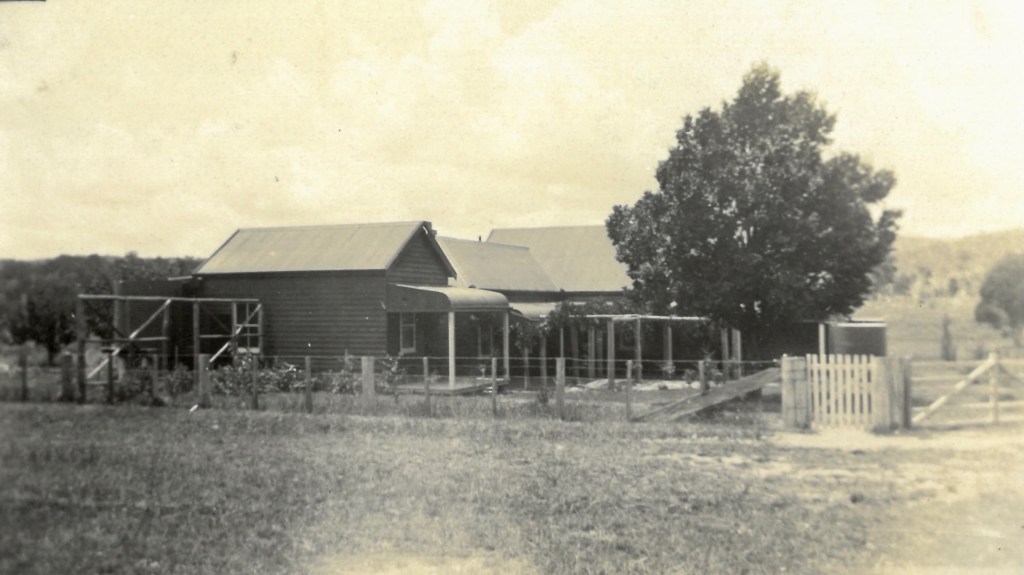
Victor relocated for a short time to Palm Beach where he lived with his wife and children, but in about May 1929 he returned to Glenbrook to work the property. Eve refused to go with him, and instead took a house in Dalley Avenue, Rose Bay, with the children. Penelope remembers this house as ‘Highfields’ and there is a photo in one of the family albums of a house with that name.
Victor had been back at Glenbrook for around four months when he wrote to Eve and implored her to return to him. When Eve refused he wrote again, but still she refused to come back to ‘the old impossible life’. He stated that it was his ‘bad luck to purchase a property stuck out in the bush’ but that he’d improved the house and brought it up to date. He also told her that the house and garden needed her attention, and suggested that there were worse places to live than Glenbrook.
By late 1931 it was obvious the marriage was at an end, and Victor and Eve’s divorce became final in May 1932. The judge, in his comments, stated:
‘Apparently this is a lady who likes the city better than the country, not realising that the place of a wife is with her husband.’
To which I make no comment.
Meanwhile, back in Armidale, Beatrice had also decided to sell up and move to Sydney. The subdivision of Wrockwardine was granted by the Armidale Council in August 1928, so Beatrice was able to sell the house with approval for a possible six building blocks adjacent to it. Wrockwardine was sold to JLG Johnstone who renamed it ‘Uloola’ – it still goes by that name today. Beatrice and her daughters moved to ‘Wemba’ in Chamberlain Avenue, Rose Bay, where she lived until her death in 1931.
Neither Valmai nor Maud ever returned to the New England region.
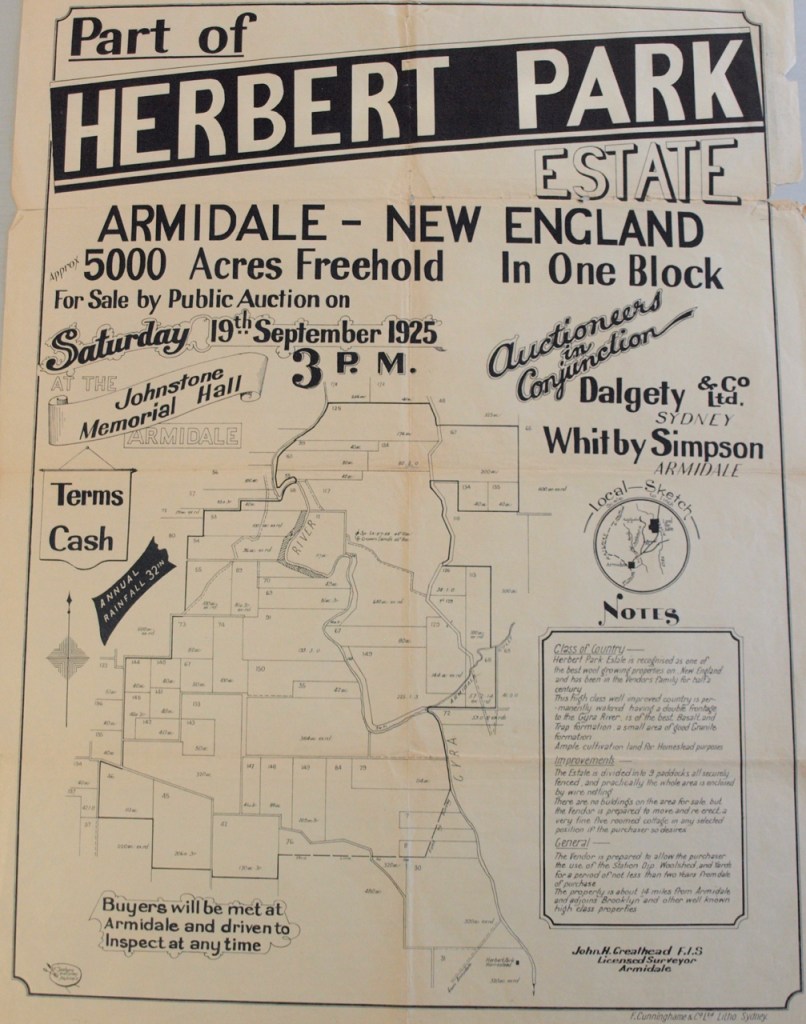
The remainder of Herbert Park was sold in September 1929 and Richard also relocated to Sydney. Victor was running Glenbrook at this time but it would’ve coincided with the period where he was travelling backwards and forwards between Sydney and Glenbrook.
After the sale of Herbert Park, efforts were made to move the chapel, as the new owners of Herbert Park were (apparently) Catholic and therefore had no use for a Church of England chapel. The chapel was pulled down and rebuilt (using most of the old, and some new, materials). To date, the chapel stands in its new location at Thalgarrah. It was dedicated in a ceremony as the Thalgarrah Chapel in January 1931. This is the chapel I was married in.
I can only speculate as to what was happening between Richard and Eve during the time they both lived in Sydney (from about 1929), while Victor was often back at Glenbrook. As mentioned, Richard had relocated to Sydney following the sale of Herbert Park. Victor and Eve’s children attended boarding school in Sydney for the three years from 1930-1932, and Eve lived in Dalley Avenue, Rose Bay.
Penelope remembers her father Victor taking her and the boys out of school at the weekends, but she doesn’t remember Eve doing the same, despite the fact that Eve lived just around the corner from Kambala (where Penelope was at school). It is difficult to say with certainty how often Victor was in Sydney, or whether Penelope’s recollections of Eve’s alleged neglect are justified! Penelope does remember the house ‘Highfields’, so perhaps she would’ve gone there with her mother at some point.
Whatever we may speculate, subsequently, in July 1932, Richard and Eve were married in a quiet ceremony in Sydney – this wedding took place just two months after Victor and Eve’s divorce became final.
Family lore alleges that Victor ‘gave everything to Eve’ after their divorce, but I’ve found no evidence to either support this story.
Victor, who owed a significant amount of money to Richard, sold Glenbrook to Richard in a complicated scenario of mortgages between the brothers. See my story “He Gave Her Everything” for details.
A few weeks before the wedding, Victor had purchased a ketch named the ‘Mitzi’ and departed from Sydney to sail for Cape York at the very top of Australia. There he eventually reconnected with a friend of the family, Nan Barton, and in 1934 they were married on Thursday Island.
Ironically, despite vowing to never again live the life of a country wife, Eve moved back to the New England with Richard after they were married. They lived for a very short time at Merilba before Richard’s lease expired in 1933. Richard, Eve and Eve’s three children then moved to Glenbrook.
Between 1933-36 Richard bought several small parcels of land in the Parish of Sandy Creek, expanding the area of Glenbrook. He also previously purchased a block of land in Sydney. The plan for this block. shows that it was part of a subdivision of land by Eve’s father Walter H Rayner (completed in March 1926). The land was situated on Palm Beach Road, Palm Beach, specifically in a little ‘V’ shaped area bounded by Palm Beach Road and Sunrise Road. It was very near to the beach, and would be worth a fortune today!
In 1936 Eve gave birth to a daughter, Mary Catherine Jenkins. The Jenkins neighbours (and good friends) Norman and Florence Strelitz had a child within two days of Mary’s birth, and there are many photos in family albums of the two young children together.
Eve’s brother Walter’s second wife Lois and her son Mark also lived at Glenbrook for a time, and there are, likewise, many photos of Mark and Mary at Glenbrook together.
Richard Jenkins died in 1956, and Victor Snr three years after that. Eve moved to 178 Allingham Street, Armidale where she remained until her death in 1971.
 Unravelled
Helen, these stories are all so interesting, and so well written. Hours, days, years I think of research. Well done and thank you for making your discoveries of valuable pieces of family history available to others.
LikeLike
Thank you Lindy 🙂
LikeLike