~by Helen Dennis, July 2026~
My new favourite ancestor is my Irish 2x-great grandmother, Mary Ann Ryan. Not because she did anything spectacular, but rather because it took me so long to figure out who she was.
Until recently, the only information I had about Mary Ann had come from two sources: her marriage certificate, where her father’s name was recorded as Timothy; and various census records which indicated she was born around 1831-32 in the (apparently fictional) locality of ‘Drumculla’ in Ireland.
This dearth of information was problematic: Ireland’s a big country and ‘Mary Ann Ryan’ was an extremely common name. Without an exact location, trying to ‘document’ her was like trying to nail jelly to a wall. After several extensive, but fruitless, searches I began to think that she had been deliberately vague because she was hiding some juicy family secret. Perhaps she even hailed from convict stock!
Frustrated, I was (almost) content to let my not-yet-favourite ancestor lie in peace. Then one afternoon out of nowhere, and despite the fact that Mary Ann had never lived in Australia, I was inspired to search the Australian newspapers.
I don’t believe in ghosts. Well, I don’t think I do. Not really. But something compelled me to randomly search those records. And, as it turned out, Australia was precisely where Mary Ann had left her most illuminating clue.
In April 1884, when she was married and living in England, Mary Ann placed the following ad in the Australian Town and Country Journal:
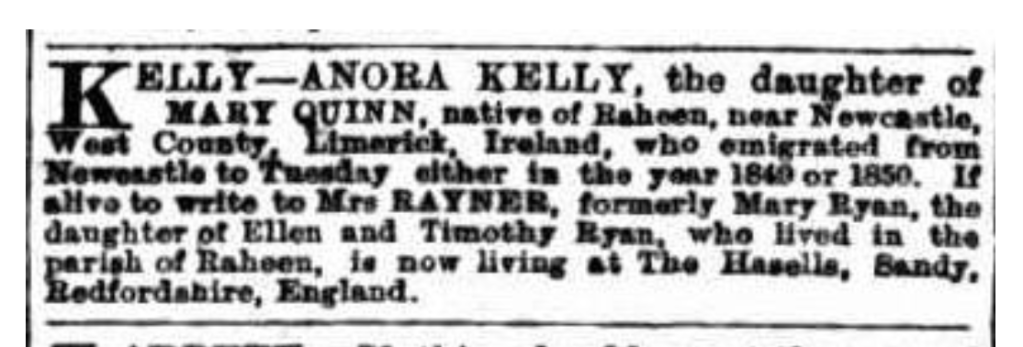
Mary Ann was illiterate, and likely dictated the contents. Some of it doesn’t make sense. For example, I believe that Anora, whoever she was, probably emigrated from Newcastle ‘to the USA’ – or ‘to t’ USA’ if spoken with an Irish accent – not ‘to Tuesday’! But comical misunderstandings aside, this little ad provides two vital pieces of information:
- Mary Ann’s parents were Timothy and Ellen Ryan, and;
- Mary (she appears to have dropped the ‘Ann’ that had been included on her marriage certificate) once lived in the parish of Raheen, near Newcastle West, in the country of Limerick.
‘Raheen’ turned out to be Raheenagh, a tiny hamlet (in Ireland, known as a ‘townland’) located within a few miles of Newcastle West, in the parish of Killeedy – which is next door to the parish of Dromcollogher. Presumably if you say Dromcollogher with an Irish accent, it sounds like ‘Drumculla’, the locality on the census document that I’d earlier written off as being fictional.
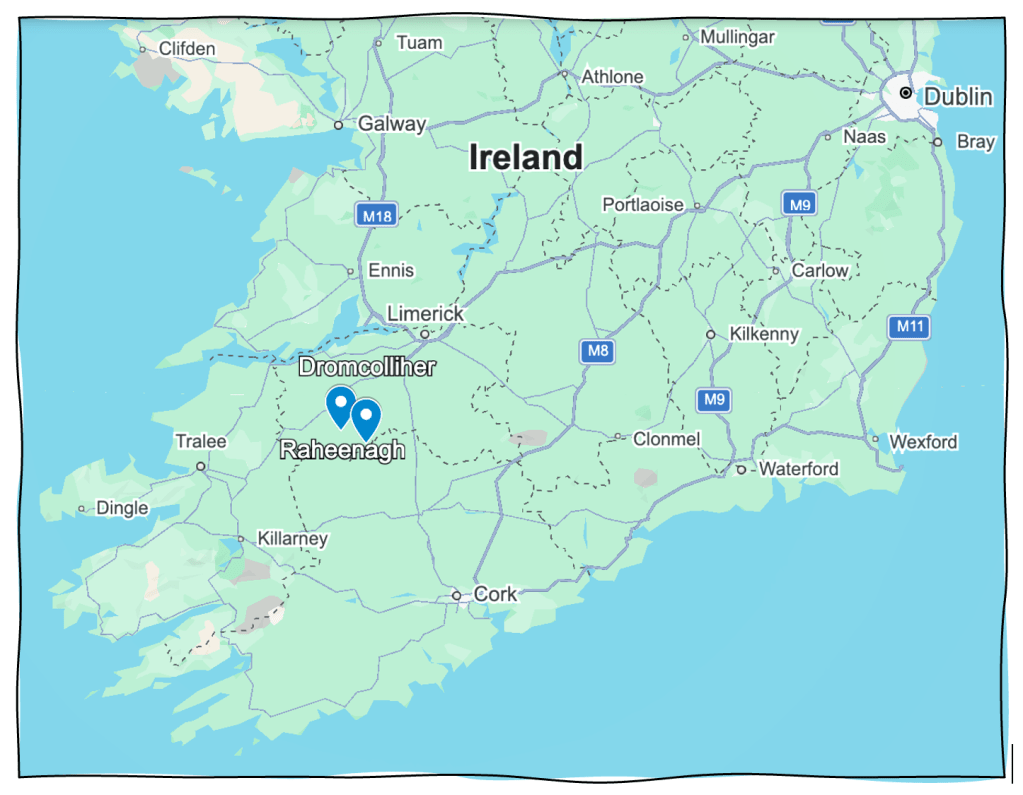
The 1830s Dromcollogher parish register was kept in Latin, which was the universal language of the Catholic church at the time. Mary Ann – recorded as Maria in the register – was baptised on 7th May 1832. She had two younger siblings: Joannem (or John) baptised in January 1835; and Annam (Anne, or Anya) baptised in October 1838. On these records, Mary Ann’s father Timothy was variously recorded as Timotheus or Thaddei, and her mother Ellen as Ellena or Helena, with the maiden name Kelly (or O’Kelly). As the records are for baptisms, there are no birth dates recorded on them, but it’s likely that Mary Ann and her siblings were baptised soon after they were born.
Land valuation records reveal that Timothy Ryan leased four acres at Raheenagh in the early 1850s. His plot was situated a few miles south of Newcastle West, on the road to Dromcollogher. There were several other small farms nearby and a little Roman Catholic chapel and a schoolhouse just up the road. Mary Ann doesn’t appear to have attended the schoolhouse though – years later, as the informant on several of her children’s birth certificates, she signed her name with an ‘x’.
The Ryans likely lived in a one or two-roomed structure with mud walls and a thatched or turf roof.[i] The majority of Timothy’s four acres would’ve been worked to pay his rent, with only a tiny portion being set aside to produce food for his own family – in effect, enough ground for a meagre potato patch. Potatoes were the staple crop of Ireland’s rural poor as they didn’t require much land, could grow in poor soils, and were also relatively healthy. Mary Ann would’ve grown up eating potatoes for breakfast, lunch and tea.
While the records don’t reveal exactly when the Ryans lived at Raheenagh, it’s likely they were there during the famine of the late 1840s. In mid-1845 potato blight caused many crops to fail leaving tenant farmers with no income and no way to feed their families. Labouring work on farms also dried up as everyone began to feel the pinch. It’s estimated that about a million people died – either from starvation, or diseases like Typhoid or Cholera – in the wake of ‘the Irish Potato Famine’.
When tenants stopped paying their rents, many landlords simply evicted them. Timothy’s landlord – who also owned a huge chunk of the surrounding land – was a protestant by the name of John Cantillon Heffernan. In March 1850, Heffernan and a large party of police and bailiffs dispossessed upwards of 30 families from their tenancies at Raheenagh, demolishing their houses in the process.[ii]
‘After turning out 34 families the bailiffs proceeded in their work of demolition, and rapidly and summarily executed the task assigned them. The dwellings which were habitable a moment before were in ruins the next. A long rope was attached to the rafters in such a manner that the entire roof was dragged off in a haul. No scene could be more heart-rending.’
Cork Examiner, 15 March 1850
This demolition likely levelled almost every tenanted house in Raheenagh. The newspaper report concluded that around 185 people had, as a result of Heffernan’s callous and unsympathetic treatment, been made homeless.
Is it any wonder, then, that Mary Ann emigrated to England? Along with many families across Ireland in similar circumstances, the Ryans would’ve had to find another way to survive. About a million people emigrated in the decade during and after the Famine. It wouldn’t surprise me if Mary Ann’s whole family emigrated, but unfortunately I’ve been unable to trace what happened to Timothy and Ellen, or Mary Ann’s siblings John and Anne.
I speculate that Anne might’ve died, and the reason I think that is because, while Mary Ann was baptised with only one Christian name, ‘Maria’ or Mary, she often went by the name ‘Mary Ann’. The records vary – sometimes she was Mary Ann and sometimes Mary. But it makes me wonder if she added ‘Ann’ onto her name in memory of, or to honour, her (late) sister. Unfortunately, neither of the parish priests in Dromcollogher or Killeedy (Raheenagh’s parish) kept a burial register.
I haven’t been able to find any record of Mary Ann between her baptism in Ireland and her marriage in England. I don’t know exactly when, or how, she left, but it was likely to have been in the late 1840s or 1850/51. Nor do I know how she met her future husband, Allen Rayner, but records suggest that their marriage might’ve been organised in a hurry.
Mary Ann married Allen Rayner in Great Chesterford, just south of Cambridge in England, on 18th September 1852 when she was 20 years old. Allen, aged 23, was an agricultural labourer whose ‘blue collar’ family had lived in nearby Cambridgeshire for generations (the earliest I’ve discovered so far is a marriage in 1588!).
Despite the fact that Mary Ann was Catholic, the couple were married at All Saints Church of England Church. As a rule, Catholics and Anglicans didn’t mix, but there does appear to have been a good reason why Mary Ann consented to marry protestant Allen: the couple’s first child, William, was born on 30th March 1853, just six months after Mary Ann and Allen’s wedding. It might be reasonable to assume that Mary Ann and Allen’s marriage was what we’d now call a ‘shot-gun wedding’.
Mary Ann went on to have another eight children; my great-grandfather Walter Hubert Rayner was the youngest, born in 1873 when Mary Ann was about 41 or 42 years old. Four of Mary Ann’s children predeceased her: three died from pulmonary tuberculosis (‘consumption’) – one when he was 13 (Fritz Alfred) and the other two as young adults (William and Julia); and the fourth (Thomas Allen), a seemingly energetic and well-liked 29-year-old, died from a long-standing unspecified illness that resulted in ‘asthenia’ (generalised physical weakness).
Following their marriage, Mary Ann and Allen, and their growing family, lived in the Great Chesterford area until Allen got a job as gamekeeper in nearby Little Abington. In Victorian times, hunting was a popular pastime for the elite. In Little Abington, a village of just over 300 people, the local toff was Henry Ewin of ‘Abington Grange’. As Ewin’s gamekeeper, Allen’s job was to keep the game on Ewin’s estate alive and well so that Ewin and his mates could shoot them. Ewin-the-toff sold up in 1866 and Allen got a job as gamekeeper at The Hasells in Sandy, Bedfordshire.
Sandy, a town that took its name from the surrounding rural sand hills, was much larger than Little Abington, having a population of around 2,000. Situated just 26 miles west of Little Abington, it’s known (now) for its ‘market gardening heritage and variety of villages, woods, heathlands, rivers and brooks’.[iii] Records reveal that later in life, once he’d retired from gamekeeping, Allen became a market gardener.
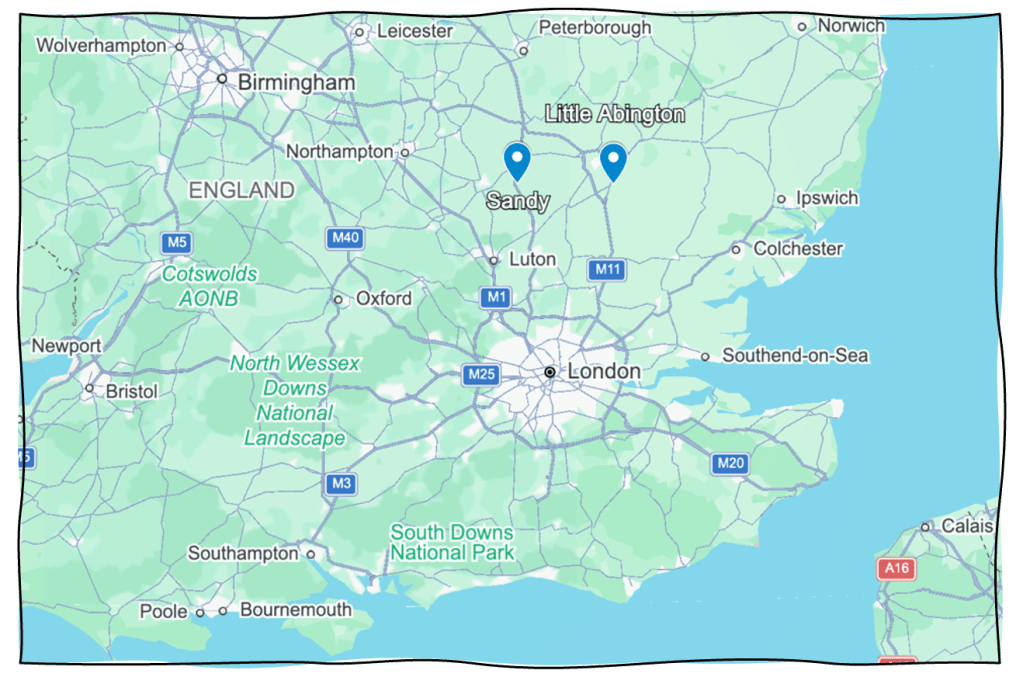
As gamekeeper at The Hasells, Allen was – as he had been at ‘Abington Grange’ – provided with accommodation. According to census records, the family lived in the ‘keepers’ cottage’, which was located on the road between Sandy and Everton. Over the decades that he worked at The Hasells, Allen prosecuted a number of poachers, one notable report revealing he was stoned by a group of men after coming across them trapping rabbits.[iv]
Of the couple’s five children that outlived Mary Ann:
- Their eldest daughter, Ellen (a lady’s maid who shared her Irish grandmother’s name), followed Mary Ann’s example and got pregnant before she married. Having done this relatively late in life (28), she only ended up having three children, but she died a very wealthy woman, her husband, John Henry Megeney, having spent the majority of his working life as butler to a rich ex-surgeon MP.
- Joseph (or ‘Joe’ as he was known) got a job at the post office in Sandy when he was 13 and remained working for the postal service his whole life. His work sent him around the country where he gathered a wife, Annie Emily Thorpe, and four children along the way.
- Sarah Ann won prizes for needlework as a child, before ‘going into service’ in London. At 40, she married William John Cook, a Lieutenant with the Grenadier Guards who ultimately achieved the rank of Captain. Sarah Ann had twin boys when she was 43 years old, spent her husband’s retirement at Muxton Lodge in Shropshire, and died a 68-year-old widow in a modest house on the south bank of the Thames in London. Like her older sister Ellen, Sarah Ann ended her life a moderately wealthy woman.
- Evelyn, or ‘Auntie Evie’, makes several appearances as an elderly lady in my grandmother’s family photo albums. I don’t know much about her other than that she was a teacher and never married. In the mid-1940s, my grandmother’s brother wrote to her from England complaining that ‘Aunt [Evie] is getting very old and cannot get about, with the result that she is getting a bit tiresome and indulging in a spot of self-pity – you know, ‘nobody-loves-an-old-woman’ sort of thing. She is very difficult and fights with everyone about the place and then grumbles because they don’t go and see her.’ Evelyn would’ve been about 70 at the time.
- By all accounts, Walter Hubert, my great-grandfather, was a larger-than-life character. He lived and married in Cairo, worked in India, migrated to Australia and owned ‘half of Palm Beach’ north of Sydney. As a young man, he kept pigeons which he exhibited at local shows.[v]
Allen Rayner died at Sandy in 1897, aged 69. Mary Ann died nine years later, on 1st December 1906, at her residence on Cambridge Road, Sandy, from chronic bronchitis, emphysema and ‘dilation of heart’. She was 75 years old.
* * *
Postscript
When Mary Ann placed the ‘desperately seeking Anora’ ad in the Australian Town & Country Journal in 1884, she would’ve been in her early 50s and coming to terms with the recent deaths of three of her children from consumption. I haven’t been able to work out who Anora Kelly was: could she have been Mary Ann’s sister-in-law? Did she marry Mary Ann’s brother Joannem? Or did Mary Ann have older brothers whose baptism records have been lost, or weren’t kept in the first place? Could Anora have perhaps been Mary Ann’s aunt?
Anora’s identity, and Mary Ann’s reason for placing the ad in a newspaper a world away, are mysteries I haven’t yet been able to solve. However, without that one little advertisement, I wouldn’t have been able to discover as much about Mary Ann’s past as I’ve now been able to. So, thank you Mary Ann for dropping the trail of breadcrumbs that led me to Raheenagh. Without your help, we’d both still be lost.
Endnotes:
[i] ‘Uncovering your ancestor’s socio-economic status’, in Judy Lucey, ‘Using Irish Land Records in Your Family History Research’, New England Historic Genealogical Society journal, p 4, American Ancestors website, https://www.americanancestors.org/sites/default/files/2024-02/Class%201_Introduction-to-Griffith%27s-Valuation-handout.pdf.
[ii] ‘Twenty-seven houses levelled: Thirty-seven families rendered houseless!!’, Cork Examiner, 15 March 1850, Find My Past newspapers.
[iii] ‘About Sandy’, Sandy Town Council website, https://www.sandytowncouncil.gov.uk/our-community/town-history/.
[iv] ‘Affray with Poachers’, Bedfordshire Mercury, 10 September 1887.
[v] ‘Pigeons’, Ampthill and District News, 27 August 1904; ‘Bedfordshire Fanciers’ Society’, Bedfordshire Mercury, 29 January 1904.


An interesting post, & a such a challenging search to find this information. Well done.
LikeLike